
The inclusive mainstream fund puts £1.6 billion into mainstream schools, 16–19 providers, and early years settings. Funding runs for three years from April 2026. It's the largest single investment in inclusive practice the sector has seen, and it comes with clear expectations attached.
Schools must publish an inclusion strategy on their website by 31 December 2026. Ofsted's updated inspection toolkit, live from September 2026, emphasises how schools deliver inclusive practice.
Guidance has moved fast. The Department for Education (DfE) published its best practice guidance in March 2026, followed by its inclusion strategy template in June 2026. It updated the guidance on 7 August, adding new resources from the Education Endowment Foundation (EEF).
This article covers what the fund is, how much your school receives, what it can be spent on, and the key deadlines you need to plan around.
What is the inclusive mainstream fund?
The inclusive mainstream fund is a new government grant that gives mainstream schools and 16–19 providers automatic funding to build inclusive practice into everyday teaching.
The fund launched in April 2026 as part of the government's wider SEND reform programme. The programme was set out in the Every Child Achieving and Thriving white paper, published in February 2026. The core idea is straightforward: strengthen universal provision so fewer pupils need a formal diagnosis before receiving support.
The DfE describes three broad areas the fund is designed to address:
- High-quality, adaptive teaching and pedagogy
- Inclusive decision-making and accessible learning environments
- Effective use of evidence-informed approaches and targeted interventions
Schools can also use the funding for targeted, evidence-based interventions for pupils who need additional support beyond the universal offer.
The commitment runs for three years, from 2026 to 2029, with a total budget of £1.6 billion. That works out to over £500 million per year. For the schools stream alone, the annual figure is £400 million. A separate £83 million per year covers 16–19 providers, including sixth-form colleges, FE colleges, and 16–19 academies. A further £47 million per year covers early years settings.
Every eligible mainstream school receives its allocation automatically through a national formula. There's no application process and no panel to satisfy.
How much will your school receive?
Funding is calculated automatically using a national formula. Your allocation depends on pupil numbers and prior attainment data.
The inclusive mainstream fund for schools splits into two streams, each with its own methodology.
Schools (5–16 provision)
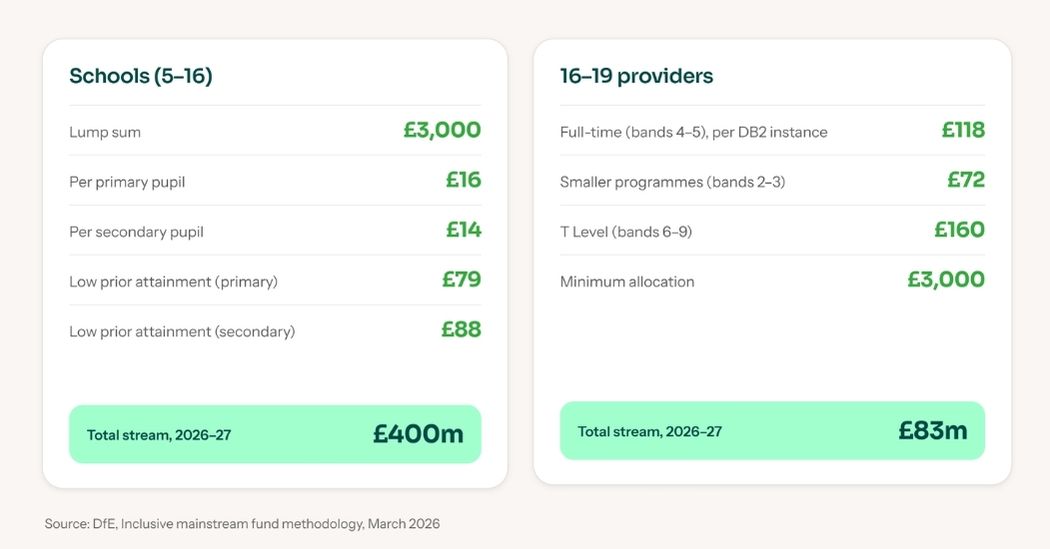
The schools stream is worth £400 million in 2026–27. Every eligible school receives a baseline lump sum of £3,000, plus per-pupil rates:
- £16 per primary pupil (Reception to Year 6)
- £14 per secondary pupil (Year 7 to Year 11)
- £79 per primary pupil with low prior attainment
- £88 per secondary pupil with low prior attainment
An area cost adjustment is applied automatically, with higher rates in London and the South East.
The DfE's published data gives a rough sense of scale. An average-sized primary school will receive around £14,000 per year. An average secondary will receive around £48,000.
16–19 provision
The 16–19 stream is worth £83 million in 2026–27 and covers schools with sixth forms, sixth-form colleges, FE colleges, and 16–19 academies. Allocations are calculated from each institution's Disadvantage Block 2 (DB2) instances in the 2025–26 funding statement. DB2 reflects students with low prior attainment.
Rates per DB2 instance:
- Full-time students (bands 4–5): £118
- Smaller programmes (bands 2–3): £72
- Band 1 students (FTE basis): £118 per FTE instance
- T Level students (bands 6–9): £160
The minimum allocation is £3,000. Rates are multiplied by your area cost adjustment. You can find your DB2 instances in the 'Distribution of disadvantage funding' table in your 2025–26 funding statement on Document Exchange.
Check your allocation
Final allocations were confirmed in May 2026. Payments began arriving in late June for local authorities and in July for academy trusts and colleges.
You can check your school's figure using the DfE's published allocations spreadsheet.
What can the funding be spent on?
Any activity funded through the inclusive mainstream fund must fall under one of the DfE's seven principles of inclusion, and spending must be evidence-informed.
The DfE's best practice guidance for schools, published on 25 March 2026 and updated on 1 July 2026, sets out these seven principles. If you've seen earlier references to 'seven themes', the DfE now uses 'principles' as the standard term. Schools must align their IMF spending to them.
The seven principles are:
- Ambitious leadership and governance that embeds inclusion
- Evidence-based support prioritising early intervention
- High-quality teaching with a curriculum designed for all learners
- Enriching provision beyond the classroom that all children can access
- A safe and respectful culture fostering belonging, attendance, and participation in learning
- Strong partnerships with families and wider services
- Inclusive environments with continuous improvements to accessibility
The conditions of grant require that schools select approaches supported by evidence. The DfE points schools to the EEF guide to inclusive teaching and the EEF's Promising Programmes list (both added in the August 2026 update) as starting points.
Focus on fewer inclusive activities done well
The DfE recommends that most schools focus on a small number of impactful activities in year one. Spreading funding thinly across all seven principles is discouraged. The aim is to establish a strong foundation of inclusive practice within the universal offer. Schools that already have robust universal provision may want to direct more of their allocation toward targeted interventions.
In practice, this might mean a secondary school investing in structured, adaptive teaching resources and diagnostic tools for one or two priority subjects. The data those tools generate then feeds directly into the inclusion strategy as evidence of impact. That's a tighter, more defensible approach than funding seven separate initiatives with £5,000 each.
What schools need to publish by 31 December 2026
Every mainstream school must publish an inclusion strategy on its website by 31 December 2026. This is a condition of the inclusive mainstream fund grant. And Ofsted's updated inspection toolkit, effective from September 2026, now references inclusive practice and schools' engagement with SEND pupils and families.
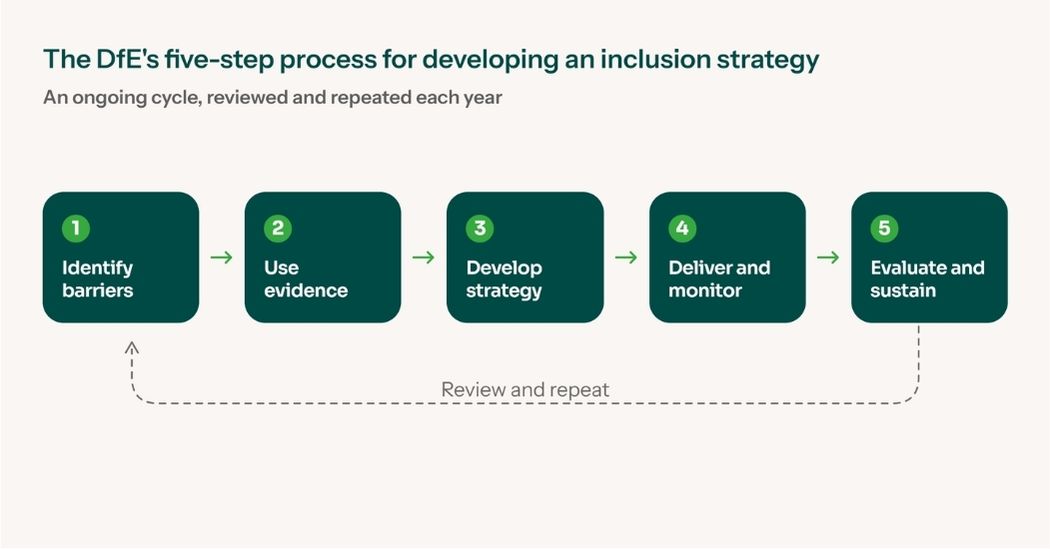
The DfE's guidance on developing an inclusion strategy, published on 25 June 2026 and updated on 7 August 2026, sets out a structured approach. If you've written a pupil premium strategy before, the format will feel familiar. The process follows five steps, and the DfE has published an official template to help schools structure their response.
The five-step process
The DfE's recommended approach mirrors the pupil premium strategy cycle:
1. Identify barriers
Map the commonly occurring barriers to learning and participation across your cohort. Draw on classroom observation, internal assessments, engagement with families, and SEND data. This isn't limited to pupils with a diagnosis or an EHC plan. It's about the barriers present across the whole cohort.
2. Use evidence
The DfE points schools to the EEF resources referenced above as starting points for selecting approaches.
3. Develop the strategy
Select approaches under the seven principles, set clear and measurable outcomes, and include budgeted costs. The strategy should cover both your universal offer and any targeted interventions.
The DfE's template requires four things:
- The barriers to learning and participation identified across your cohort
- The activities invested in to address those barriers
- Intended outcomes
- A review of the previous academic year
Schools can create multi-year strategies, but they must be reviewed annually.
4. Deliver and monitor
Track pupil outcomes, support staff through ongoing CPD, and create regular opportunities to review whether the strategy is working. This is where your data matters. Schools that can show engagement, progress, and impact at student, class, or cohort level will have a much stronger position come inspection.
5. Evaluate and sustain
Measure success based on attendance, attainment, progress in learning, wellbeing, belonging, and engagement. The DfE expects evaluation to be ongoing, not a one-off review in December.
What Ofsted will look for from September 2026
Ofsted's updated inspection toolkit, effective from September 2026, puts new emphasis on how schools deliver inclusive practice. Schools inspected in the autumn term should expect inclusion to be a focus, even before the December strategy publication deadline.
Inspectors will look at whether leaders engage proactively with pupils and families to reduce barriers to learning and wellbeing, and whether pupils facing those barriers are achieving well. Ofsted has also introduced the term 'leaders who have an inclusion role' within its inspection materials. This signals that inclusion is every leader's responsibility, not just the SENCO's.
The toolkit does not reference the inclusion strategy document by name. Publishing that strategy by 31 December 2026 is a condition of the IMF grant, not an Ofsted requirement. But the overlap is clear: schools that have started their strategy work will be better placed to demonstrate the inclusive practice inspectors are now looking for.
Ofsted's blog on the updates is clear that inspectors won't hold schools to account for reforms that haven't happened yet. But they will assess how well leaders know their cohort and whether they engage proactively with pupils and families to reduce barriers to learning. Schools that can't demonstrate that won't meet the expected standard for inclusion.
If you're expecting an inspection in the autumn term, starting your strategy work in September gives you both the evidence base for inspectors and a head start on the December deadline.
How Up Learn supports schools using the inclusive mainstream fund
Up Learn maps directly to the DfE's seven principles of inclusion, with evaluation data schools can use to evidence their IMF spending.
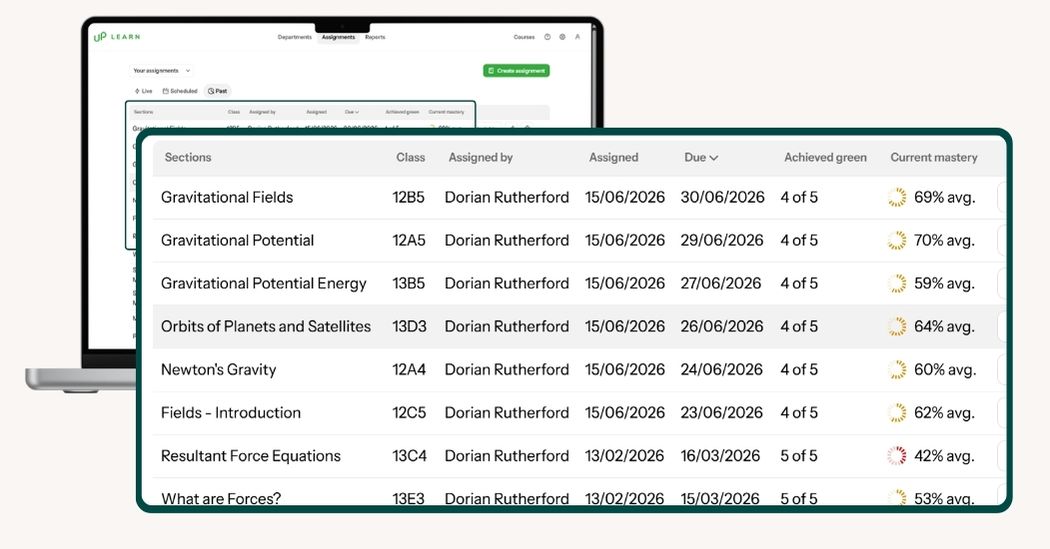
Up Learn covers A Level Biology, Chemistry, Economics, Physics, Psychology, and Maths, as well as GCSE Combined Science and Triple Science. Students get structured, mastery-based content covering the full specification for each subject. For teachers and leaders, it provides dashboards that track engagement, completion, and progress without adding to workload.
Here's how that maps to the seven principles:
- Leadership and governance. Dashboards give SLT a real-time view of engagement and progress by student, class, subject, or whole school. The data is exportable and feeds directly into your inclusion strategy and Ofsted reporting.
- Evidence-based early intervention. Cohort views flag unmastered topics from week one. Refresh Knowledge and diagnostic quizzes identify and close gaps before they widen, without waiting for a formal diagnosis.
- High-quality adaptive teaching. Every student receives the same mastery-based, exam-board-specific content regardless of starting point. AI personalisation adapts to each student's pace and prior gaps. Content is built by subject experts and grounded in cognitive science.
- Accessible provision beyond the classroom. Students get 24/7 access on any device, with unlimited online tutor support. There's no cost to families and no timetable required.
- Safe and respectful culture. Self-paced learning with a consistent, predictable structure helps reduce performance anxiety, particularly for neurodiverse students.
- Strong partnerships with families. Automated parent and carer progress emails keep families updated on completion, overdue work, and next steps. No extra workload for staff.
- Inclusive environments. Captions are being rolled out across courses, supporting students with hearing impairments and those with English as an additional language.
What the evaluation data shows
Up Learn's 2025 Evaluation of Learning Outcomes, an analysis across approximately 2,500 exam entries from 23 schools, found that:
- Completing 90% or more of assignments correlates with approximately one full grade increase
- Achieving mastery (80%+) in at least 20% of sections correlates with nine additional months of progress
- Completing 30 or more Refresh Knowledge sessions correlates with a 70% increase in the likelihood of achieving A* or A
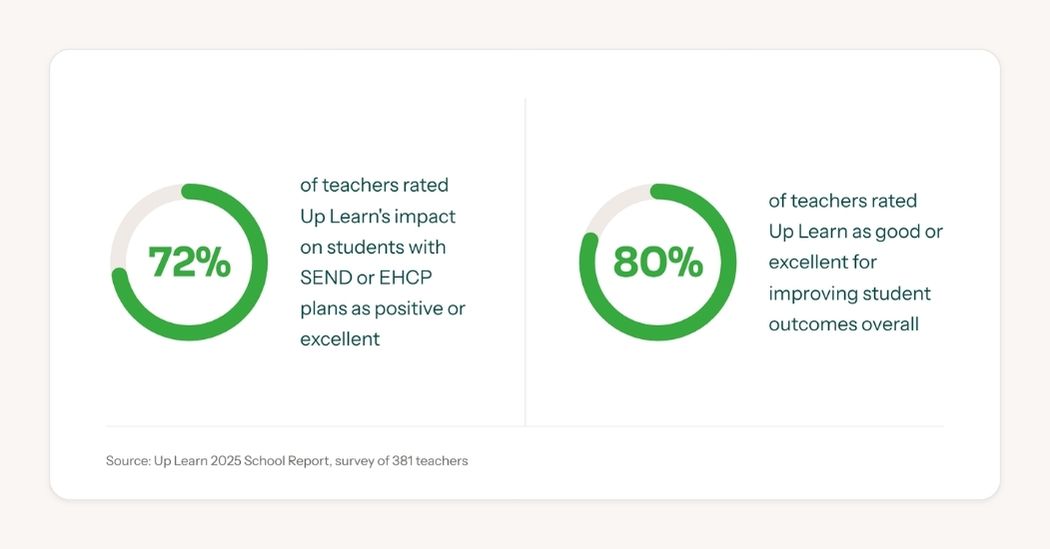
Up Learn's 2025 School Report surveyed 381 teachers. Of those, 72% rated Up Learn's impact on students with SEND or EHCP plans as positive or excellent. Eighty per cent rated Up Learn as good or excellent for improving student outcomes overall.
Step four of the DfE's process is 'deliver and monitor'. Up Learn's dashboards track engagement, completion, and mastery at student, class, subject, or whole-school level. That data gives you a clear, defensible answer to the question every school leader will face: what did the funding change?
Key dates and next steps
The inclusive mainstream fund runs until 2029, but the first deadline is 31 December 2026.
Allocations were confirmed in May 2026, and payments arrived in late June and July. The DfE published its inclusion strategy guidance and official template on 25 June, then updated the guidance on 7 August to add the EEF's inclusive teaching resources. If you haven't reviewed those yet, the links are in the sections above.
Here's what's ahead:
- September 2026: Ofsted's updated inspection toolkit takes effect. Embed your chosen approaches from the first week of term and start tracking progress through your data systems.
- October–November 2026: Collect impact data. Completion rates, mastery levels, and cohort progress all feed directly into your inclusion strategy.
- 31 December 2026: Deadline. Publish your inclusion strategy on your school website.
- 2027–2029: The fund continues. Use year one data to refine your strategy and deepen implementation.
If this is useful for your planning, share it with your team. Email this article to a colleague.

'When students miss school, it gives them the chance to go over what they've missed in an interactive way. It's useful to have another way for students to learn.'